Brick-and-mortar stores still 'very important', says Uniqlo as it plans to expand in Singapore
SINGAPORE: Fifty-fifty as it works on adding better means to store on its due east-commerce platform, brick-and-mortar stores remain a "very important" of Uniqlo's business concern.
This is why the Japanese wear brand plans to keep expanding its retail store presence in Singapore, said Mr Yuki Yamada, the chief executive officeholder of Uniqlo'south operations hither.
"We will be opening more than retail stores as part of our expansion (and) to go on to meet our customers' needs," he told CNA in an interview on Thursday (October vii).
"We (can't) disclose the number yet … but we are preparing some new store openings right at present."
Now in its twelfth year of operations in Singapore, Uniqlo has 26 stores across the country and employs almost one,400 people.
The COVID-nineteen pandemic has created an urgent need for retailers to go digital. Likewise, Uniqlo has ramped up its online shopfront over the by year but information technology does not meet 1 replacing the other.
"(A) physical store is still very important … and the best location to understand customer needs," said Mr Yamada. "We always interact with customers through the staff and we like to understand product feedback, what they want, and what tin can be improved."
And so last year, it relaunched three stores with a new retail concept.
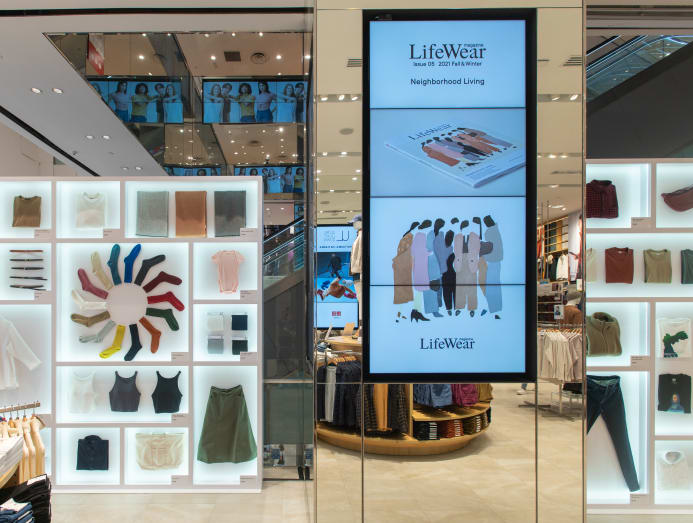
Located at Orchard Fundamental, Ion Orchard and Plaza Singapura shopping malls, these Uniqlo Town stores, equally they are chosen, want to provide more than just a shopping experience.
For instance, the flagship shop at Orchard Central partners local entrepreneurs to hold workshops ranging from art and craft to fashion upcycling.
Efforts seemed to have paid off, co-ordinate to Uniqlo, which said footfall at these three Uniqlo Town stores were upwardly by an average of 130 per cent since the reopening in July last twelvemonth.
That is not to say that the casualwear chain was not afflicted by the pandemic.
Store sales and footfall traffic took a hit last yr, said Mr Yamada, adding that the worst impact came from the two-month "circuit billow" last year that brought the country to a near-standstill.
Merely it spotted new needs amid pandemic-induced lifestyle changes. With the rise of work-from-home arrangements for instance, it decided to spruce up its offering with a new range of daily essentials.
"Everybody has to work from home so we (provide) a expert range of merchandise like lounge wear, inner wear and if yous get out, nosotros have a mask. If you want to exercise, we have sports utility items," said the chief executive. "We continuously provide essential items to the Singapore marketplace."
Sales have since recovered, with "good traffic" observed across its stores in the city areas and the heartlands this twelvemonth, said Mr Yamada, who declined to reveal specific figures.
"We encounter the sales recovering but (compared with) before COVID-19, nosotros haven't recovered fully yet because the borders are closed," he added, noting that the dearth of travel has crimped demand for its top-selling winter clothes.
Uniqlo'due south parent company, Fast Retailing Group, said in its latest earnings report that both revenue and profit saw "big increases" in the nine months ended May. The latter rose to 227.9 billion yen, from 134.4 billion yen in the year-agone flow that was hit hard by the pandemic.
Overall, the Tokyo-based retail group expects operating profit for the fiscal yr ending August to rise 64 per cent year-on-year to 245 billion yen, information technology said in the study released in July.
Back in Singapore, the retailer continued to adapt to other challenges such as the perennial labour shortage which heightened terminal year when some of its strange employees chose to head abode amongst the pandemic.
Self-checkout counters, for instance, were rolled out at about seventy per cent of its stores over the past year to alleviate the manpower woes.
At the same time, it launched new initiatives to cater to those who adopt to store online, such every bit offering online-only discounts and extra product sizes. It is also partnering third-party logistics firms to handle deliveries.
"Before the pandemic, we put in a lot effort to improve e-commerce. And so during the pandemic, we saw stiff sales growth for e-commerce and I call back customers likewise realise e-commerce services (are) really quite user-friendly," said Mr Yamada.
"But as we mentioned, both offline and online channels are of import for the states."
He stressed that Uniqlo believes in having "good synergy" between its online and offline offerings. This is why it launched new services such as "click and collect" where customers can make their purchases online and choose to collect the items at whatsoever Uniqlo Town stores on the same solar day.
Mr Yamada said the company continues to work on improving its online-to-offline strategy, and its finish goal is one that "intelligently fuses online and the physical store functioning for shoppers".
"What we want to achieve here is when customers think of buying clothes, they think of buying Uniqlo. I recall that's what nosotros want to achieve at the cease of the twenty-four hours," he said.
Source: https://cnalifestyle.channelnewsasia.com/business/uniqlo-singapore-retail-brick-mortar-stores-still-important-295221

Post a Comment for "Brick-and-mortar stores still 'very important', says Uniqlo as it plans to expand in Singapore"