Everything You Need to Know About Karl Marx
Every bit the world reflects on 200 years since the nascence of Karl Marx, his writings are existence sampled by more and more people. If you're new to the work of i of the greatest social scientists of all time, here'due south where to start.
Marx's own writing
James Muldoon, Academy of Exeter
The long history of savage, totalitarian "Marxist" regimes around the earth has left many people with the impression that Marx was an authoritarian thinker. But readers who dive into his work for the starting time time are often surprised to discover an Enlightenment humanist and a philosopher of emancipation, 1 who envisaged well-rounded human beings living rich, varied and fulfilling lives in a mail service-capitalist society. Marx'due south writings don't merely propose a revolutionary political projection; they offer a moral critique of the alienation of individuals living in capitalist societies.
1. An Introduction to a Contribution to the Critique of Hegel's Philosophy of Right (Bachelor here)
Originally published in 1844 in a radical Parisian newspaper, this fascinating short essay captures many of Marx's early on criticisms of modern society and his radical vision of emancipation. It also introduces several of the central themes that would shape his later writings.
Marx claims that the bourgeois revolutions of the 18th century may take benefited a wealthy and educated course, but did non challenge private forms of domination in the manufactory, domicile and field. Marx theorises the revolutionary bailiwick of the working class, and proposes its historic job: to abolish private holding and achieve self-emancipation.
2. Economical and Philosophic Manuscripts of 1844 (Available here)
Non published within his lifetime, and simply released in 1932 past officials in the Soviet Wedlock, these notes written by Marx are an of import source for his theory of capitalist alienation. They reveal the essential outline of what "Marxism" is, and provide the philosophical basis for humanist readings of Marx.
In these manuscripts, Marx analyses the harmful effects of the organisation of labour in mod industrial societies. Modernistic workers, he argues, accept become estranged from the goods they produced, from their own labour activity, and from their swain workers. Rather than achieving a sense of satisfaction and self-actualisation in their labour, workers are left exhausted and spiritually depleted. For Marx, the antidote to modernistic alienation is a humanist conception of communism based on free and cooperative production.
iii. The Communist Manifesto (Available here)
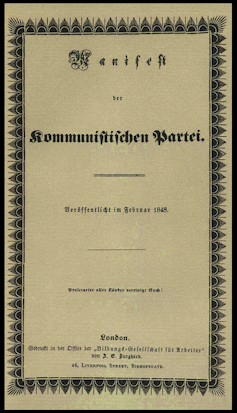
Opening with the famous line, "a spectre is haunting Europe – the spectre of communism", the Communist Manifesto has get one of the nigh influential political documents e'er written. Co-authored with Friedrich Engels, this pamphlet was commissioned by London'southward Communist League and published on the cusp of the various revolutions that rocked Europe in 1848.
The manifesto presents Marx's materialist formulation of history and his theory of class struggle. Information technology outlines the growing tensions between the bourgeoisie and the proletariat under capitalist relations of production, and predicts the triumph of the workers.
4. The High german Ideology (Available here)
For anyone seeking to understand Marxism'due south deeper philosophical and historical underpinnings, this is one of his most important texts. Written in effectually 1846, again with Engels, The German Credo provides the full development of the two men's methodology, historical materialism, which seeks to understand the history of humankind based on the development of its modes of product.
Marx and Engels debate that individuals' social consciousness depends on the cloth conditions in which they live. He traces the development of different historical modes of product and argues that the nowadays capitalist one will be replaced by communism. Some interpreters view this text as the point where Marx's thought began to emerge in its mature form.
5. Capital (Volume i) (Available hither)
Published in 1867, Capital letter is Marx's disquisitional diagnosis of the capitalist mode of product. In it, he details the ultimate source of wealth nether capitalism: the exploited labour of workers. Workers are free to sell their labour to any capitalist, but since they must sell their labour in order to survive, they are dominated past the class of capitalists as a whole. And through their labour, workers reproduce and reinforce both the economical weather of their existence and also the social and ideological structure of their club.
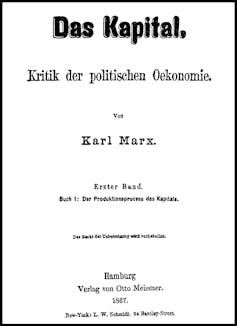
In Capital, Marx outlines a number of capitalism's internal contradictions, such as a failing charge per unit of profit and the tendency for the germination of backer monopolies. While certain aspects of the text have been questioned, Marx's analysis informs economic debate to this day. For anyone trying to understand why commercialism keeps falling into crisis, it's still hugely relevant.
On Marx and Marxism
Robert Jackson, Manchester Metropolitan University
ane. A Companion to Marx's Capital – David Harvey
From social movements to student reading groups, from Thomas Piketty'south Capital in the Twenty-Showtime Century to articles in the Financial Times, Marx'due south economic writings are at the centre of debate once again. And ane of the figures about associated with these discussions is the geographer David Harvey.
Based on his popular online lecture series, Reading Capital letter with David Harvey, this book makes Marx's Capital letter accessible to a broader audience. Guiding readers through Marx'southward challenging (only rewarding) study of the "laws of motion" of commercialism, Harvey provides an open and critical reading. He draws out the connections betwixt this globe-irresolute text and today'south club – a order which, afterward all, is nonetheless shaped by the economical crisis of 2008.
2. Karl Marx: A Nineteenth-Century Life – Jonathan Sperber
For Jonathan Sperber, a historian of modern Germany, Marx is "more a figure from the past than a prophet of the present". And, as its title suggests, this biography places Marx's life in the context of the 19th century. It's an accessible introduction to the history of his political idea, peculiarly as a critic of his contemporaries. Sperber discusses Marx in his many roles – a son, a student, a journalist and political activist – and introduces the multitude of characters connected with him. While Francis Wheen's well-known Karl Marx: A Life is a more than freewheeling account, Sperber's writing is both highly readable and more than deeply rooted in historical scholarship.
3. From #BlackLivesMatter to Black Liberation – Keeanga-Yamahtta Taylor
Writing about the US just over 150 years ago, Marx noted that: "Labour in a white skin cannot emancipate itself where information technology is branded in a black skin." And the influence of his ideas nigh the human relationship between race and class is visible in debates right up to the present day.
Penned by academic and activist Keeanga-Yamahtta Taylor, who came to popular prominence in the contempo #BlackLivesMatter movement, this is a timely read for those interested in the various ways Marx'due south thought is being rebooted for the 21st century. A penetrating book, it connects the origins of racism to the structures of economic inequality. With plenty of Marxist ideas (among others) in her toolbox, Taylor critically examines the notion of a "colour-blind" society and the Usa's mail service-Obama order to great effect.
iv. Why Marx was Right – Terry Eagleton
A telephone call to reconsider the widely accepted notion that Marx is a "dead dog" from renowned literary theorist Terry Eagleton. In this provocative and highly readable book, Eagleton questions the plausibility of ten of the almost common objections to Marx's thought – among them, that Marx's ideas are outdated in mail service-industrial societies, that Marxism always leads to tyranny in do, that Marx'due south theory is deterministic and undermines human freedom. Always witty and passionate, Eagleton peppers his spirited defence (with some reservations) of Marx's ideas with his own literary and cultural insights.
v. Jacobin magazine – edited by Bhaskar Sunkara (available online)
In the era of the Occupy movement, "taking a knee" and #MeToo, the discussion of Marx's ideas has gained an increasing presence on the net. One of the most notable examples is the socialist magazine and online platform Jacobin, edited by Bhaskar Sunkara, which currently reaches around 1m viewers a month.
Roofing topics from international politics and ecology movements to the recent education strikes in Oklahoma and West Virginia and Bernie Sanders'south presidential entrada, it's a lively source for anyone who wants to run into an analysis of contemporary politics that'south influenced by Marx'south thought.
Source: https://theconversation.com/karl-marx-ten-things-to-read-if-you-want-to-understand-him-95818

Post a Comment for "Everything You Need to Know About Karl Marx"